The Strategic Value of AI Agents in Modern Business: Use Cases, Performance Gains, and Competitive Advantage

Fawaz Mohamed
Lead Management Strategist
Mar 21, 2026
Introduction
Artificial intelligence has evolved from a supplementary tool into a foundational component of modern business operations. Among its most transformative developments is the emergence of AI agents—autonomous systems capable of executing tasks, analyzing data, and making decisions with minimal human intervention. These agents are increasingly embedded within customer relationship management systems, marketing platforms, and operational workflows, enabling organizations to operate with greater precision, speed, and scalability.
In a competitive and rapidly evolving marketplace, businesses that adopt AI-driven systems are achieving measurable improvements in efficiency, customer engagement, and revenue generation. Conversely, organizations that delay implementation risk falling behind competitors who are leveraging automation and data intelligence to optimize performance.
Quantifiable Business Impact of AI Adoption
The adoption of AI agents is supported by substantial empirical evidence demonstrating their impact on business performance. Organizations utilizing AI-driven sales and marketing systems have reported increases in lead generation of up to 50%, alongside cost reductions of up to 60% (Cirrus Insight, 2025). These outcomes are primarily driven by enhanced targeting capabilities, predictive analytics, and automated customer engagement.
In terms of productivity, AI tools have been shown to significantly augment workforce efficiency. Employees supported by AI technologies have experienced up to a 66% increase in task output, reflecting a considerable improvement in operational capacity (Vena Solutions, 2026). Additionally, automation technologies can free approximately 20% of organizational capacity, enabling teams to focus on strategic and revenue-generating activities (Salesgenie, 2025).
From a financial perspective, AI-enhanced CRM systems demonstrate strong returns on investment. Businesses earn an average of $8.71 for every dollar invested in CRM platforms, with additional gains reflected in a 29% increase in sales and a 34% improvement in productivity (Teamgate, 2025; Digital Socius, 2025). These metrics underscore the role of AI as both an efficiency driver and a revenue enabler.
Core Applications of AI Agents in Business Operations
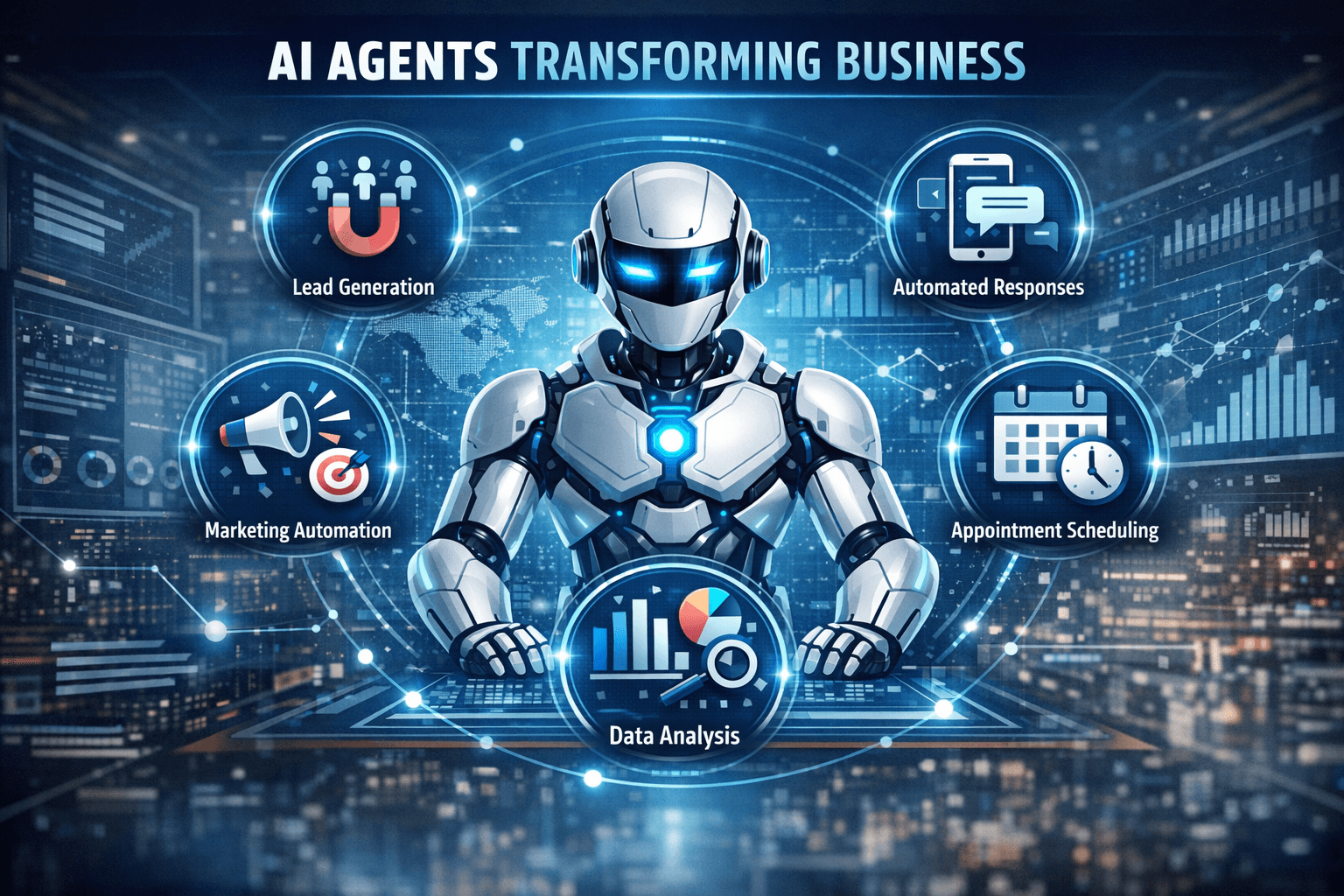
AI agents deliver the greatest value when deployed across integrated systems that unify customer data, communication channels, and operational workflows. One of the most impactful applications is automated lead capture and qualification. AI agents can engage prospective customers in real time through digital channels such as chat interfaces, SMS, or email, while simultaneously assessing lead quality based on predefined criteria such as budget, timeline, and intent. Organizations leveraging AI-driven engagement tools report that 64% experience an increase in qualified leads, with conversion rates improving by up to 20% (Martal Group, 2026).
Another critical application is automated follow-up and lead nurturing. AI agents can maintain consistent, multi-channel communication with prospects, ensuring that engagement is sustained throughout the customer journey. This is particularly valuable given that sales professionals spend a significant portion of their time on administrative tasks. Research indicates that sales representatives devote up to 60% of their time to non-selling activities, a gap that AI agents can effectively address through automation (Salesforce, 2026).
AI agents also contribute to appointment scheduling and pipeline management by integrating with calendars and CRM systems to coordinate bookings, send reminders, and manage follow-up sequences. These capabilities reduce friction in the sales process, minimize missed opportunities, and enhance overall pipeline efficiency. Studies have shown that AI integration can result in 30–50% faster response times, which is a critical factor in improving customer engagement and conversion outcomes (Kixie, 2025).
In the domain of marketing, AI agents facilitate dynamic campaign optimization and personalization. By analyzing behavioral data and segmenting audiences, these systems can deliver tailored messaging at scale. This capability is increasingly important, as 73% of consumers indicate a preference for personalized engagement and are less responsive to generic outreach (Salesforce, 2026). AI-driven personalization enables businesses to deliver more relevant and impactful communications, thereby improving conversion rates.
Additionally, AI agents support workflow automation across business operations, handling repetitive and time-intensive tasks such as data entry, reporting, and internal notifications. Organizations that implement automation technologies effectively have been shown to achieve up to 57% greater efficiency in their processes, highlighting the operational benefits of integrating AI into core workflows (Salesgenie, 2025).
A further extension of AI capability lies in API-driven integration, which enables organizations to connect disparate systems into a cohesive ecosystem. Through APIs, AI agents can synchronize data across platforms, trigger complex workflows, and support highly customized business processes. This level of integration enhances scalability and allows businesses to adapt their systems to evolving operational requirements.
Enhancing Customer Experience Through Intelligent Systems
Beyond operational efficiency, AI agents play a critical role in enhancing the customer experience. By leveraging real-time data and predictive analytics, these systems can anticipate customer needs, deliver timely responses, and provide personalized interactions across multiple touchpoints. This results in higher levels of engagement, improved satisfaction, and stronger customer relationships.
AI-driven CRM systems have also demonstrated the ability to increase customer retention and repeat business. For example, organizations integrating AI into their customer engagement strategies have reported improvements in repeat sales of approximately 15%, reflecting the long-term value of personalized and consistent communication (Kixie, 2025). As customer expectations continue to evolve, the ability to deliver seamless and relevant experiences will remain a key differentiator.
Strategic Implications of AI Agent Adoption
The integration of AI agents represents a broader shift toward intelligent, data-driven business operations. These systems enable organizations to move beyond reactive processes and adopt a more proactive and strategic approach to growth. By combining automation, analytics, and real-time decision-making, AI agents empower businesses to optimize performance across all stages of the customer lifecycle.
Importantly, AI adoption also enhances workforce effectiveness. Research indicates that 78% of professionals believe AI enables them to focus on higher-value work, underscoring its role in augmenting human capabilities rather than replacing them (Sopro, 2025). This alignment between technology and human effort is critical for achieving sustainable growth.
Furthermore, many organizations report achieving measurable returns within a relatively short implementation period, often within the first year. This demonstrates that AI adoption is not only strategically advantageous but also financially viable in the near term.
Conclusion
AI agents are rapidly becoming an essential component of modern business infrastructure. Their capacity to automate workflows, enhance decision-making, and improve customer engagement positions them as a critical tool for organizations seeking to remain competitive in an increasingly digital economy.
The applications of AI agents—ranging from lead generation and qualification to marketing optimization and operational automation—offer substantial opportunities for improving efficiency, increasing revenue, and enhancing customer satisfaction. As the gap between adopters and non-adopters continues to widen, timely implementation will be a defining factor in long-term success.
Organizations that embrace AI agents as part of a cohesive, integrated system will be well-positioned to lead in their respective industries.
References (APA Style)
Cirrus Insight. (2025). AI in sales statistics and trends.
Digital Socius. (2025). CRM statistics and performance insights.
Kixie. (2025). CRM and AI performance data.
Martal Group. (2026). Lead generation statistics and AI impact.
Salesforce. (2026). State of sales statistics.
Salesgenie. (2025). Sales productivity statistics.
Sopro. (2025). AI sales and marketing statistics.
Teamgate. (2025). CRM trends and ROI statistics.
Vena Solutions. (2026). AI productivity statistics.